Sustainable & Biophilic Design Trends for Dubai Offices in 2026
Dubai's skyline keeps getting taller. But inside the buildings, something quieter and more important is happening: office interior Dubai projects are finally…
Dubai's skyline keeps getting taller. But inside the buildings, something quieter and more important is happening: office interior Dubai projects are finally being designed around the people who use them, not just the brand that owns them.
By 2026, sustainable and biophilic design isn't a "nice to have" anymore in office design Dubai — it's what employees expect, what leases require, and what top talent notices the moment they walk through the door. A generation of tenants has grown up with wellness-first thinking baked into how they choose where to work, and landlords across Business Bay, DIFC, and JLT are responding with green building certifications that didn't exist a decade ago.
This shift isn't cosmetic. It's operational, financial, and cultural — and it's changing what a genuinely competitive office fit-out Dubai brief looks like in 2026.
Why 2026 Is the Tipping Point
A few forces are converging at once:
- Regulatory pressure. Dubai's Net Zero 2050 strategy and DEWA's green building requirements are pushing new commercial developments toward higher sustainability benchmarks, and that pressure flows down into how tenants fit out their space.
- Talent competition. With so many companies competing for the same skilled workforce, office environment has become part of the employer value proposition — not just salary and title.
- Real estate economics. Sustainability-certified buildings are increasingly commanding better occupancy rates and tenant retention, which means landlords are more willing to support biophilic and green fit-out requests than they were five years ago.
- Post-pandemic expectations. Air quality, natural light, and access to nature-adjacent space stopped being abstract wellness talk and became things employees actively evaluate before accepting a role.
Here's what's actually shaping office fit-out Dubai projects this year — and how to think about applying each trend to your own space.
1. Living Walls Are Replacing Feature Walls
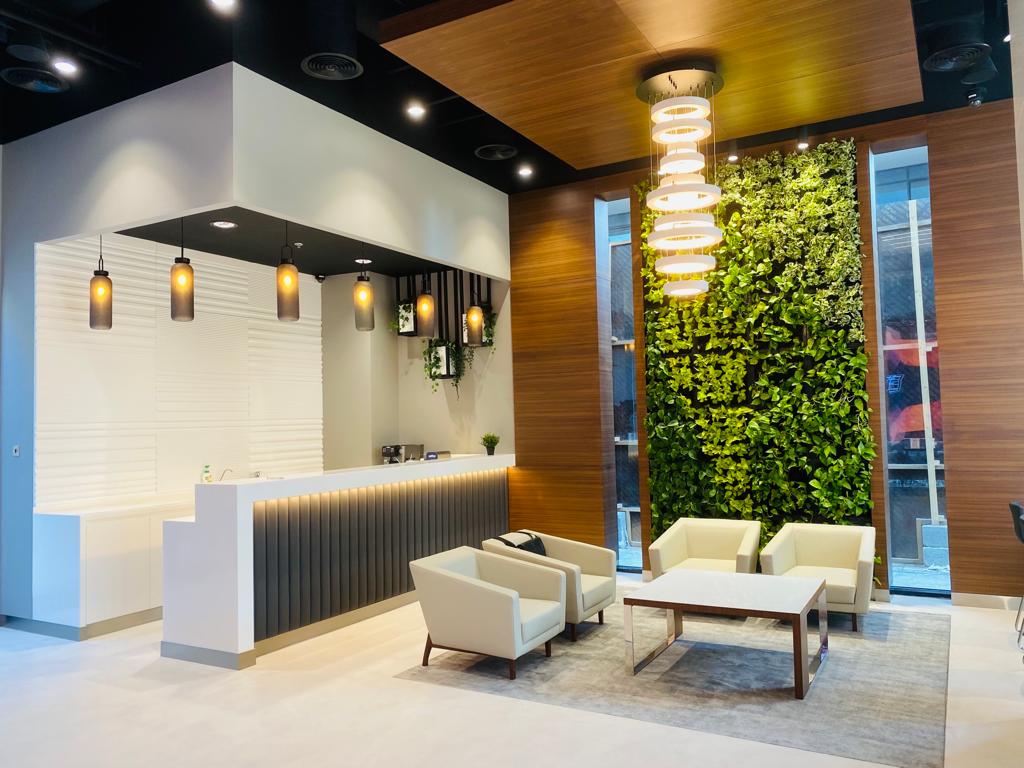
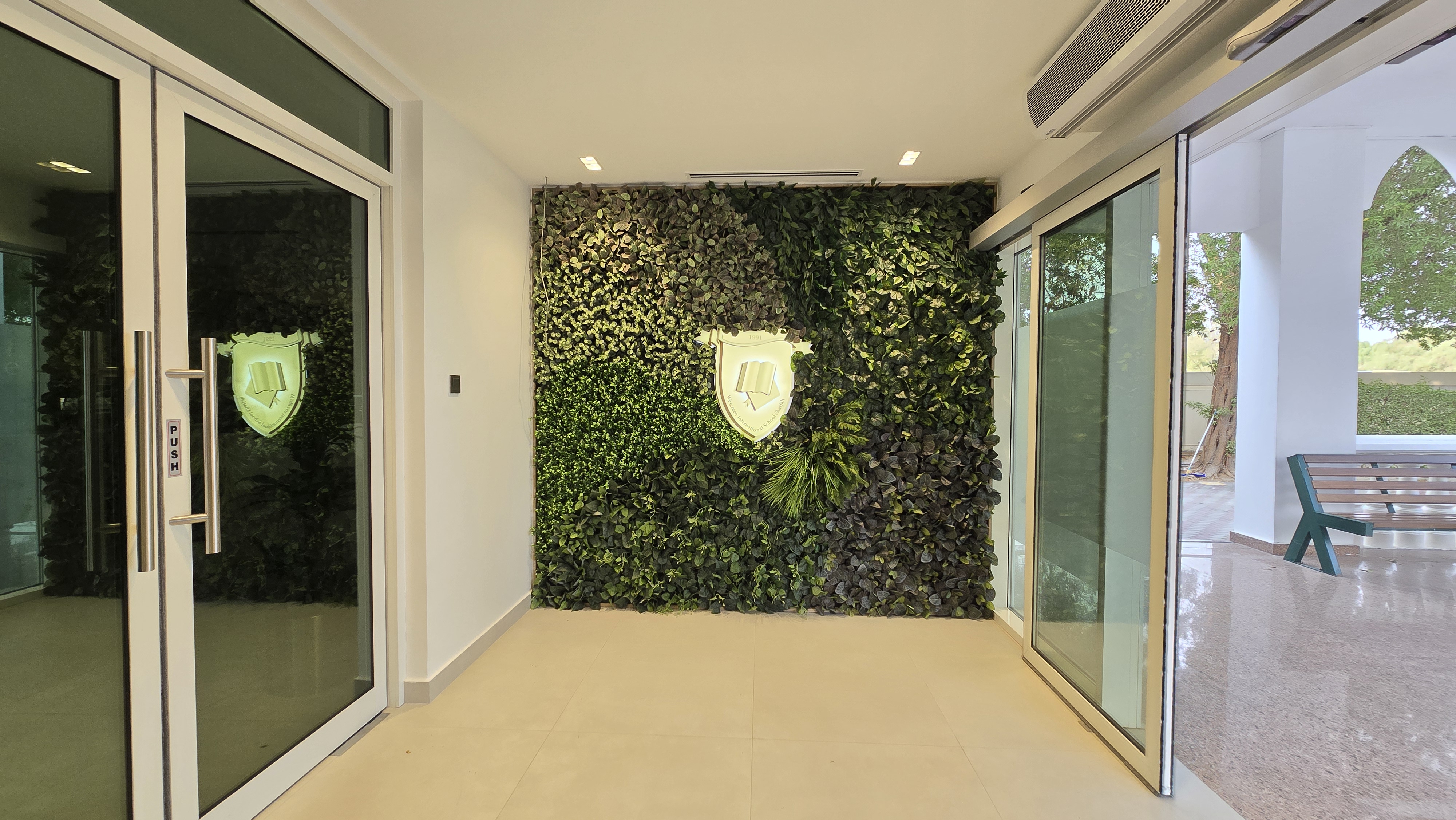
The Instagram-worthy branded wall is old news. Green walls — real or high-quality preserved moss — are showing up in reception areas and breakout zones because they do three things at once: improve air quality, cut acoustic noise, and instantly soften a space that's otherwise glass, steel, and desks.
Live green walls need irrigation planning, adequate light (natural or grow-light), and a maintenance contract — worth factoring into your budget from day one rather than as an afterthought. Preserved moss walls are the lower-maintenance alternative: no watering, no daylight requirement, and a similar acoustic and visual softening effect, though without the air-purifying benefit of living plants.
Either way, it's one of the simplest ways to elevate an office interior design without touching the layout — which makes it a popular first move for companies renovating within an existing floor plate.
Where it works best: reception desks, waiting areas, meeting room backdrops, and the dead space behind pantry counters.
2. Daylight Is Being Treated as a Design Material
With Dubai's DEWA green building push and stricter LEED expectations on new commercial leases, layouts are shifting to pull natural light deep into the floor plate. Glass-partitioned meeting rooms, lower workstation panels, and desks positioned along window lines aren't aesthetic choices anymore — they're core to modern office design Dubai thinking, blending energy efficiency with wellness.
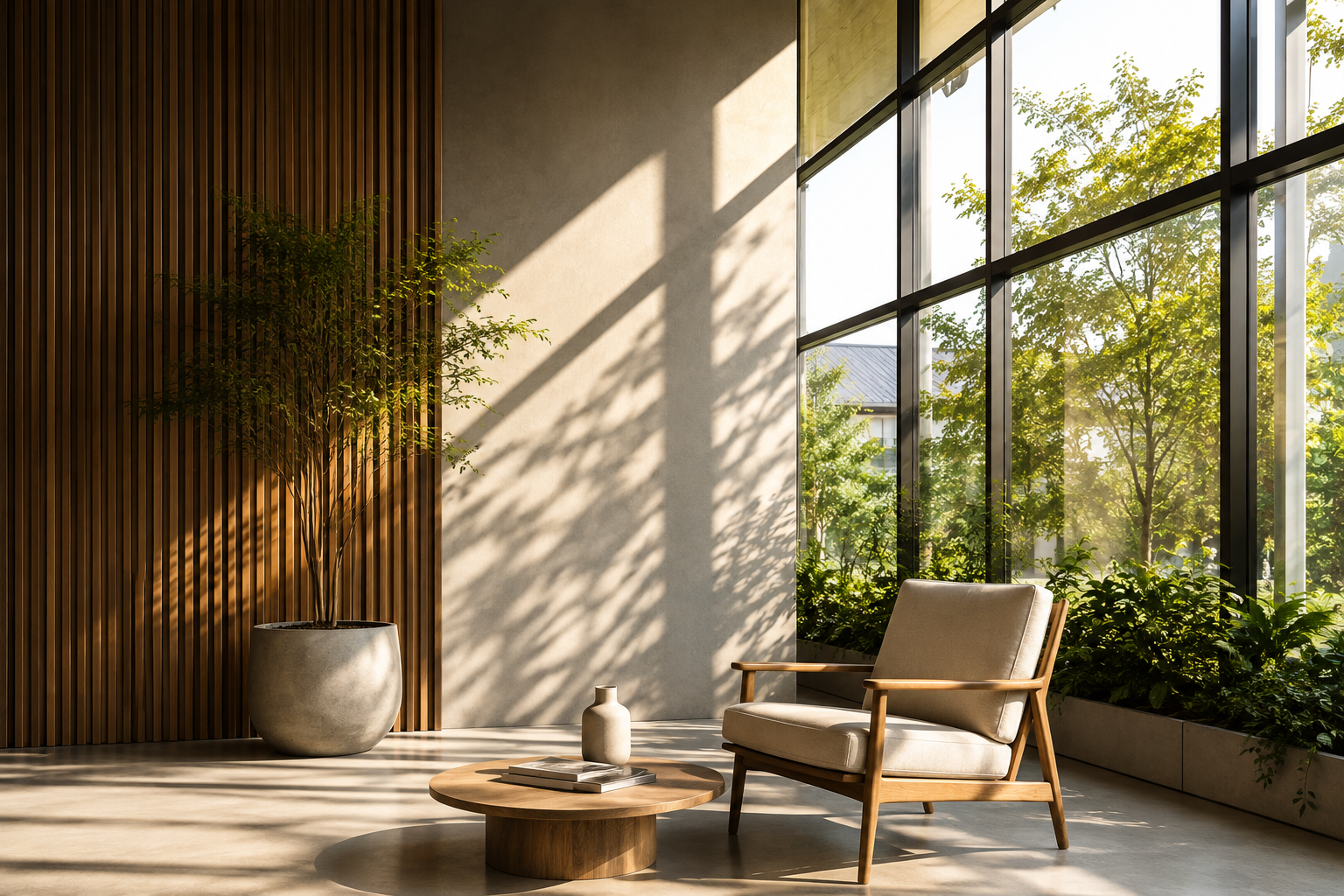
This also means rethinking where enclosed rooms go. The old model put private offices along the windows and open desks in the interior, cutting off daylight from the people who need it most for focused, everyday work. The 2026 approach flips that: cellular offices and phone booths move toward the core, and daylight-dependent zones — collaboration areas, informal seating, hot desks — take the perimeter.
Layered lighting design matters just as much as glazing. Tunable LED systems that shift color temperature through the day (cooler for focus hours, warmer toward evening) are increasingly specified alongside daylight-harvesting sensors that dim artificial lighting automatically as natural light increases — cutting energy use without anyone touching a switch.
3. Circular Materials Are Becoming a Client Question, Not a Designer's Pitch
More Dubai clients are now asking directly: "Where does this material come from, and what happens to it after?" Reclaimed timber, recycled aluminium ceiling systems, and low-VOC finishes are moving from "sustainable options" to default specification on RFPs across the region.
A few materials worth knowing as you brief your fit-out partner:
- Reclaimed and FSC-certified timber for joinery, reception desks, and feature walls — sourced from responsibly managed forests or repurposed from prior builds.
- Recycled aluminium and steel for ceiling grids, partition frames, and structural elements, which cuts embodied carbon significantly versus virgin metal.
- Low-VOC paints, adhesives, and sealants, which directly improve indoor air quality — a factor that's now commonly tied back to measurable productivity and sick-day data in workplace studies.
- Carpet tiles with recycled content and take-back programs, so old flooring doesn't automatically end up in landfill at the next refresh.
Specifying circular materials doesn't have to mean a cost premium across the board — in some cases (reclaimed timber, recycled metal ceiling systems) it can be cost-neutral or cheaper, depending on sourcing and availability in the local market.
4. Biophilic Isn't Just Plants Anymore
The 2026 version of biophilic design goes beyond potted plants at the entrance. It's about mimicking nature's patterns — organic curves instead of hard right angles, natural materials like rattan and limestone, water features for acoustic calm, and layouts that create a visual connection to the outdoors even on a mid-rise floor with no view.
Designers now talk about biophilic design in terms of specific patterns, not just greenery:
- Direct connection to nature — actual plants, water, natural airflow where the building allows it.
- Indirect connection to nature — natural materials, nature-inspired patterns and colors, imagery, and natural light and shadow play.
- Spatial qualities — prospect (open views across a space), refuge (smaller, enclosed nooks to retreat to), and a sense of mystery or discovery as people move through a floor plate.In practice, this means a well-designed biophilic office balances open, airy collaboration zones with smaller, softer retreat spaces — not just a wall of plants near the lift lobby.
5. Wellness Zones Are Now a Line Item in the Budget
Quiet rooms, indoor courtyards, and nature-adjacent breakout corners used to be the first thing cut when budgets tightened. In 2026, they're being protected — because companies are realizing retention is cheaper than recruitment, and design plays a direct role in both.
Common wellness-zone additions we're seeing specified more often:
- Quiet/focus rooms separate from meeting rooms — no screens, no calls, just a space to decompress or work without interruption.
- Prayer and reflection rooms, an established requirement in Dubai fit-outs, increasingly designed with the same material and lighting care as the rest of the office rather than treated as a leftover space.
- Indoor greenery courtyards or atriums where floor plates allow, used for informal meetings as much as downtime.
- Height-adjustable and ergonomic furniture as a baseline spec rather than an upgrade option.
None of these need to be large. Even a single well-placed quiet room of 6–8 square metres, finished with the same material language as the rest of the space, sends a clear signal to employees about what the company actually prioritizes.
6. Circadian and Air Quality Systems Are Entering the Spec Sheet
A newer trend for 2026: mechanical and electrical specifications are starting to include indoor air quality monitoring and circadian lighting controls as standard line items, not premium add-ons. CO2 sensors that trigger increased fresh-air intake, and lighting systems tied to time-of-day rather than fixed brightness, are becoming easier and cheaper to install as the technology matures — and easier to justify to ownership when tied to occupant wellbeing and energy savings simultaneously.
What This Means for Your Budget
A common misconception is that sustainable and biophilic fit-outs are automatically more expensive. In practice, the cost picture is mixed:
- Higher upfront cost: living walls with irrigation, circadian lighting systems, and some certified sustainable finishes.
- Cost-neutral or lower: daylight-optimized layouts (fewer enclosed rooms means less partition material), recycled-content ceiling and flooring systems, and low-VOC finishes, which are now widely available at standard market pricing.
- Long-term savings: reduced energy consumption from daylight harvesting and efficient lighting, lower churn-related refit costs from durable, well-specified materials, and — increasingly cited in workplace research — reduced absenteeism linked to better air quality and daylight access.
The right approach is to treat sustainability and biophilia as a lens applied across the whole brief, not a separate line item bolted on at the end. That's where an experienced fit-out partner earns their fee — knowing which moves matter most for a given space and budget.
Why This Matters for Office Fit-Out Companies in Dubai
Dubai's commercial real estate market is competitive, and tenants increasingly weigh sustainability credentials alongside rent per square foot. Working with experienced office fit-out companies Dubai businesses trust means a biophilic fit-out isn't just good for the planet or employee wellbeing — it's a genuine differentiator when a company is trying to attract talent in a city full of other options.
It also matters at lease-renewal and resale stages. Buildings and suites that were fitted out with adaptable, durable, sustainably-sourced materials tend to need less remedial work between tenancies — a point increasingly raised by landlords and facilities managers during scope discussions.
Frequently Asked Questions
Is biophilic design more expensive than a standard office fit-out? Not necessarily. Some elements (living walls, circadian lighting) carry a premium, but many sustainable choices — daylight-optimized layouts, recycled-content materials, low-VOC finishes — are cost-neutral or cheaper at current market pricing in Dubai.
Do I need a certified green building to do a biophilic fit-out? No. Biophilic and sustainable design principles can be applied inside almost any shell and core, though buildings with better access to natural light and outdoor views make certain elements — like daylight harvesting — more effective.
How long does a sustainable office fit-out take in Dubai? Timelines are generally comparable to a standard fit-out of the same size and complexity. The main variables are material lead times (reclaimed or certified timber can take longer to source) and any MEP upgrades for air quality or lighting control systems.
What's the easiest first step if I can't do a full renovation? Start with what changes fastest and cheapest: a living or preserved-moss wall in reception, low-VOC repainting, better task lighting, and reallocating one enclosed room as a quiet/wellness space. These moves don't require a full floor-plate redesign.
The Bottom Line
Sustainable and biophilic design in Dubai offices has moved from trend to baseline expectation. The companies getting it right aren't just adding plants — they're rethinking materials, light, layout, and wellness as one connected system.
If you're planning an office interior Dubai fit-out or renovation in 2026, the question isn't whether to go biophilic. It's how to do it in a way that actually fits your space, your team, and your budget.
Thinking about your next fit-out? Let's talk through what a sustainable, biophilic workspace could look like for your team — get in touch and we'll help you map it out.